
JOHNSON CONTROLS
Streamlining video investigation workflows for 3x faster search experience in a legacy security system (Exacqvision)
ROLE
UX Designer
TIMELINE
Oct 2024 - May 2025
8 months
TEAM
1 Product Manager
1 Engineer
3 UX/Product Designers (including me)
ABOUT
Exacqvision is a video management system that helps businesses to monitor, manage, and review security footage across diverse camera devices on their premises.
tools

What I focused on?
Led the end-to-end redesign, focusing on improving the user experience of the forensic search workflow(reviewing security footage) and drive product metrics.
Collaborated with product managers to align on product strategy, with engineers to maintain technical feasibility and with other designers to conduct design reviews.
CONTEXT
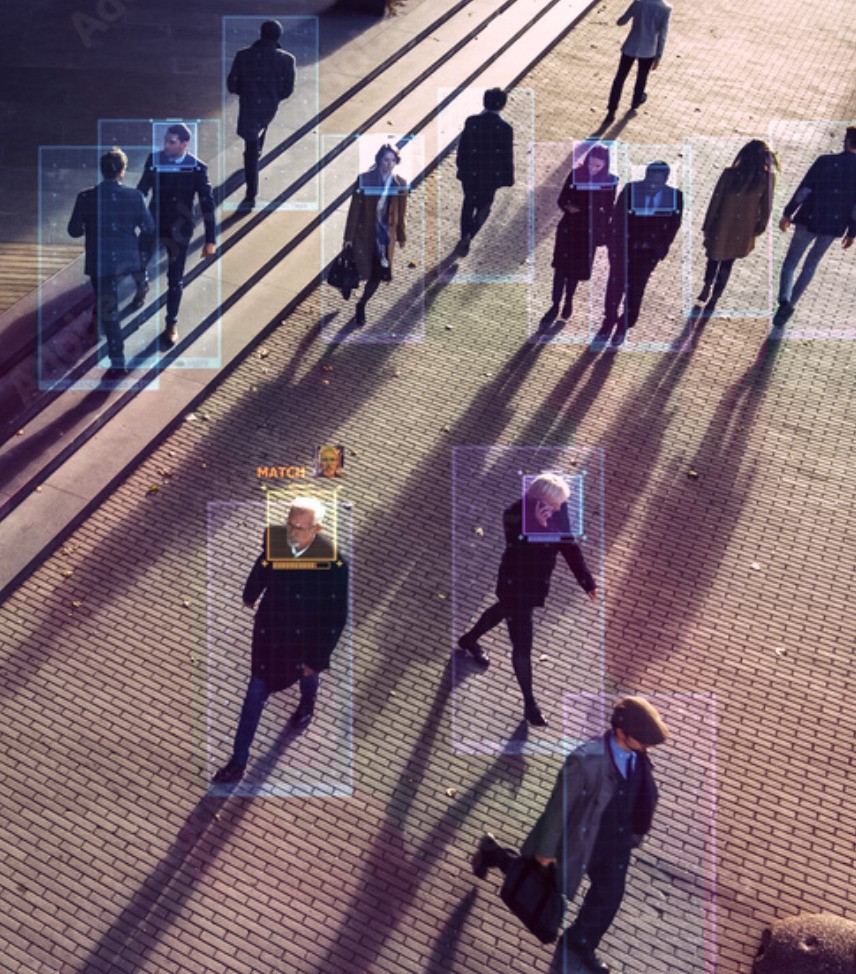
Have you seen those CCTV portraits of suspects and wondered how operators find that one clear frame among hours of security footage?
Forensic Search which helps security operators to search for specific events or instances within recorded video footage. The workflow advanced capabilities like AI filtering to narrow results by person, vehicle, object etc., turning a manual search into a targeted one.
What Prompted Us to Redesign this Workflow?
Security operators investigating incidents struggle to find relevant footage quickly because ExacqVision's forensic search workflow is unintuitive and not user-friendly, increasing time-to-resolution.
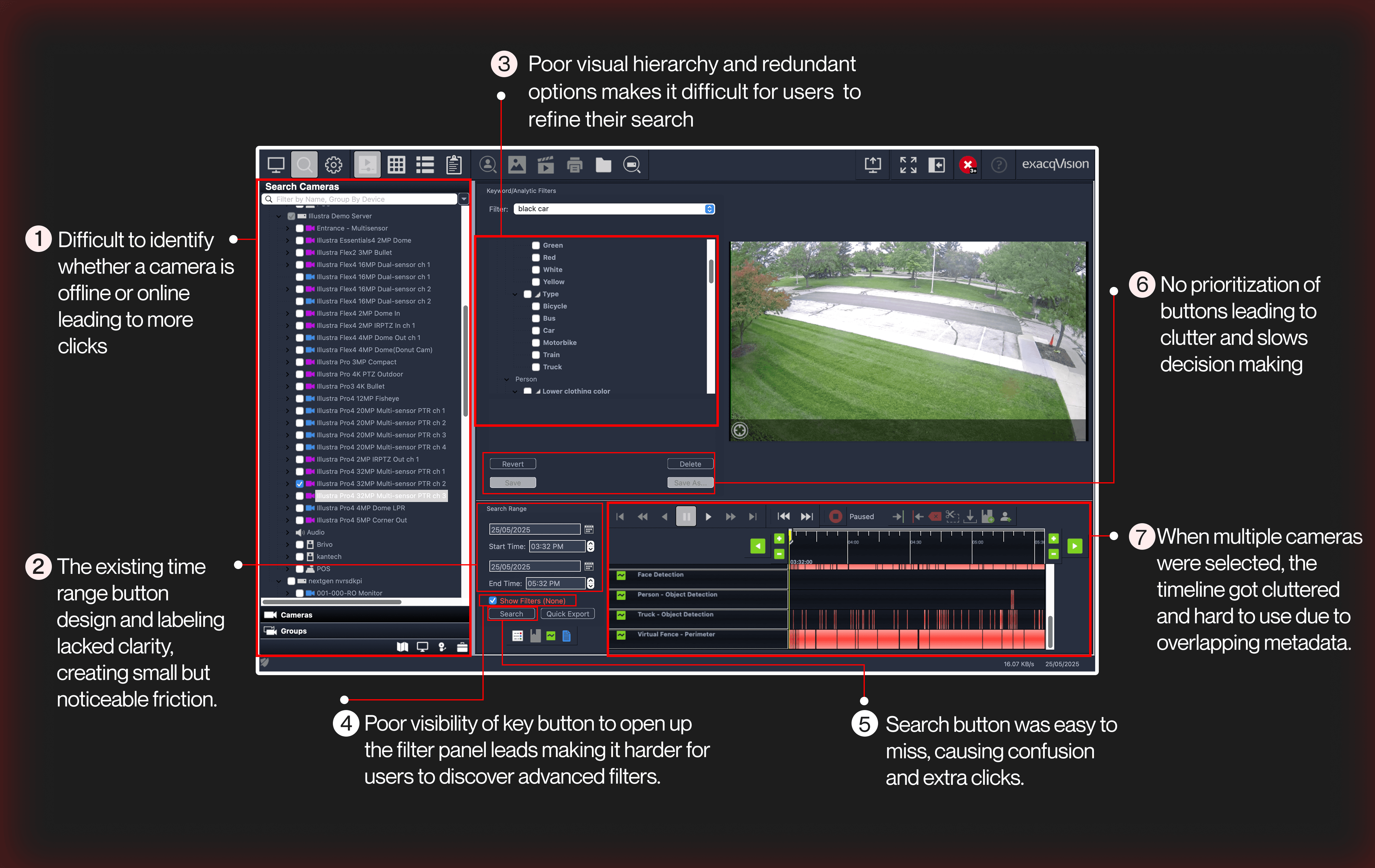
The result? This is a critical issue since only 2% of users adopt this feature. Forensic search has strong capabilities but users aren't discovering them and not able to use the feature effectively. They encounter the interface, lose momentum, and default to workarounds.
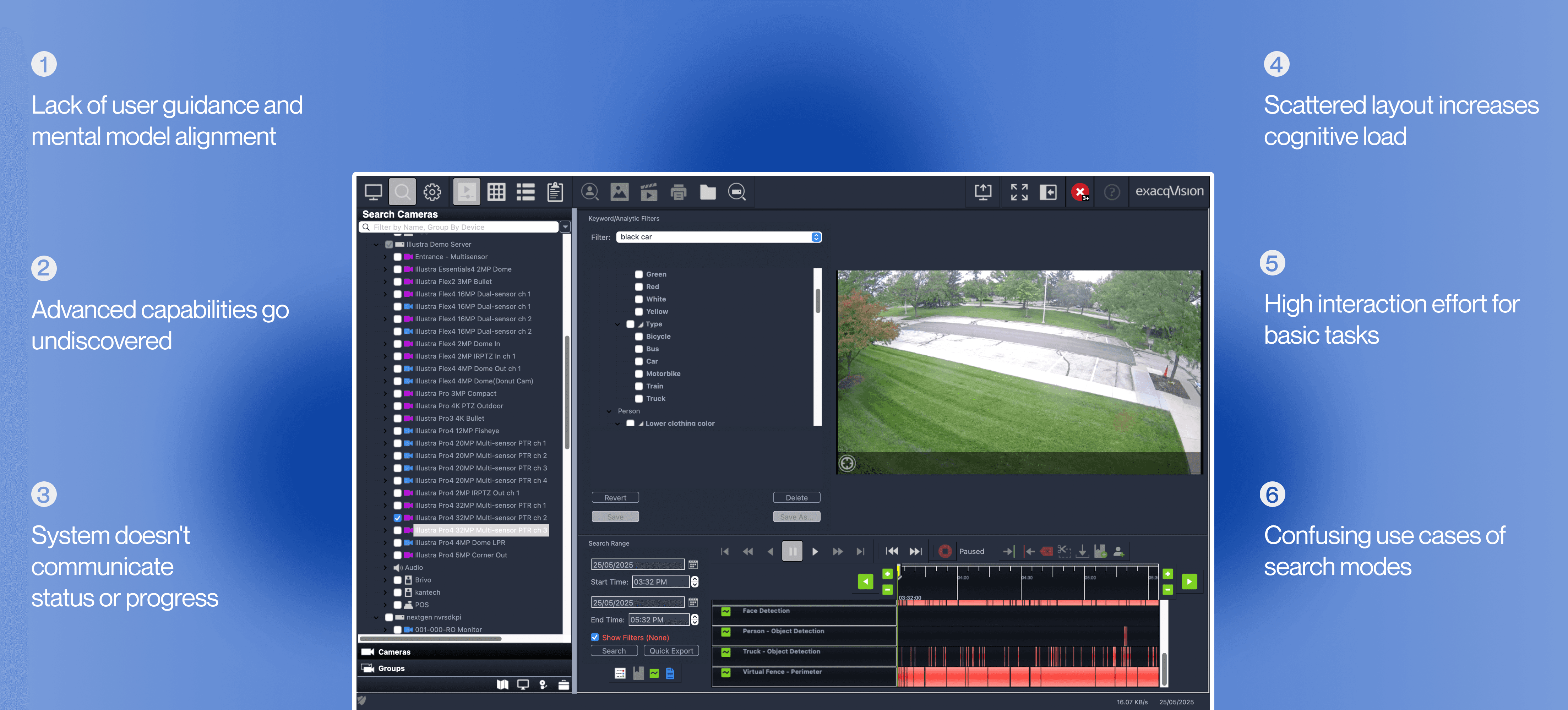
Also, the majority of people using this system aren't experts. They're novice security operators, often new to the job and rarely trained on this part of the software. What should take minutes takes much longer and over time and if the issue persists, they might stop trusting the tool altogether.
Opportunity
Extending the competitive differentiation advantage with a better search experience.
ExacqVision has a clear edge: its edge architecture supports a wide range of camera brands, something cloud competitors can't match. That's driving customer growth today. But the landscape is shifting.
Cloud competitors are delivering polished, intent-based forensic search experiences and ExacqVision's forensic search UX hasn't kept pace. The hardware advantage alone won't hold. This redesign closes that gap.
Strategy
Balancing quick wins with long-term vision
Closing the UX gap required alignment across design, product, and engineering. Through cross-functional discussions and deciding on a prioritization matrix, I identified two solution phases: short-term usability improvements and a redefined workflow vision tied to the product roadmap.
This strategy balances user needs with business reality: reduce risk, maintain familiarity, and solve the usability issues directly impacting retention and feature adoption.
Solution phase 1 - Short term IMPROVEMENTS
How might we quickly improve discoverability and usability within the current system?
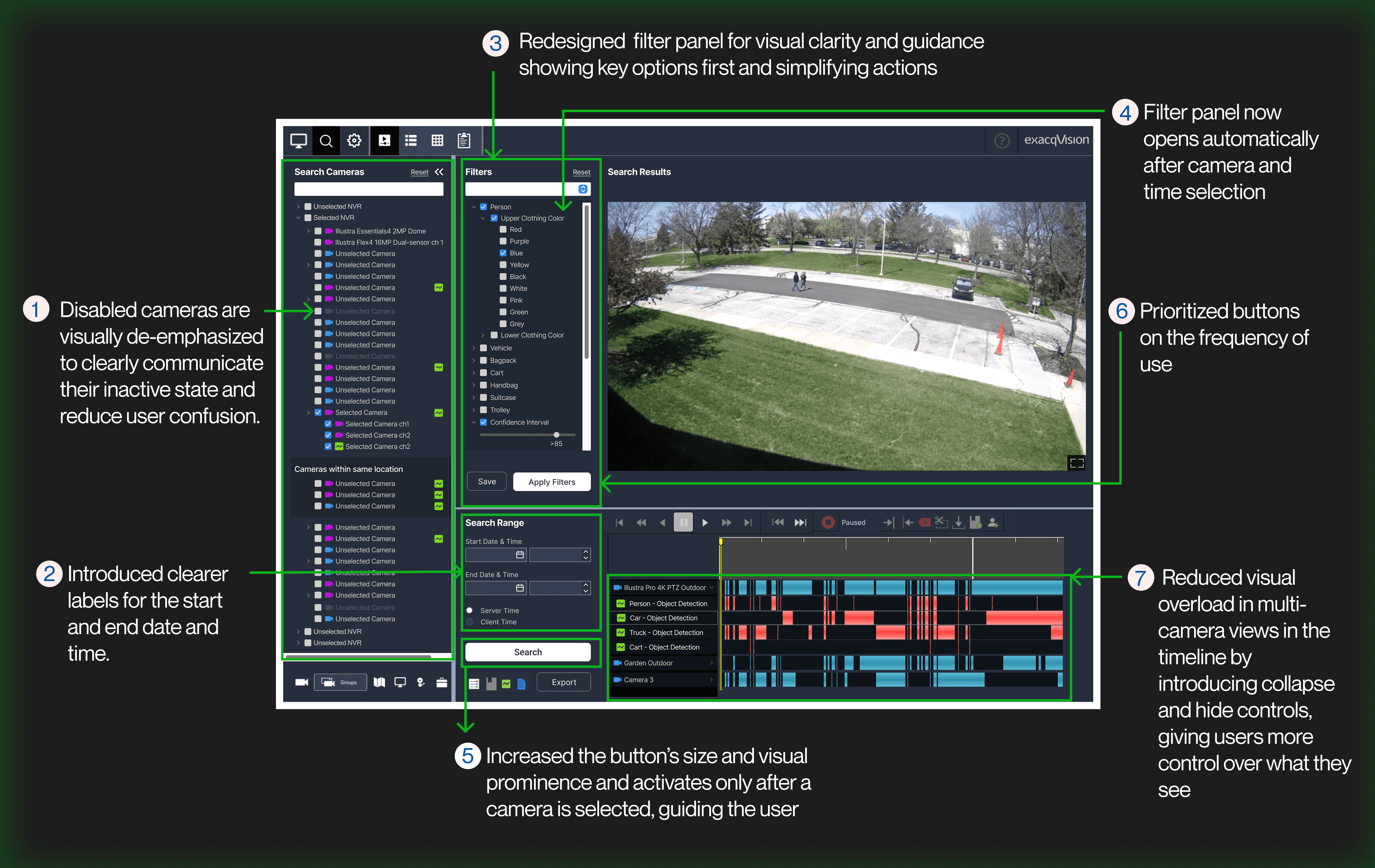
We focused on targeted usability fixes: high priority, high feasibility. Validating with engineering, we identified a set of improvements that could ship within a short period. The design objectives were
Visibility
Surface key features where user expects them.
Clarity
Simplify labels and reduce cognitive load to guide users toward action
Efficiency
Smarter defaults and fewer clicks shorten time-to-task.
Solution phase 2 - Long TERM IMPROVEMENTS
What workflow and interaction changes can we introduce moving forward to align the system more closely with user needs, mental models, and business goals?
To redefine the workflow, I examined the experience through a dual lens.
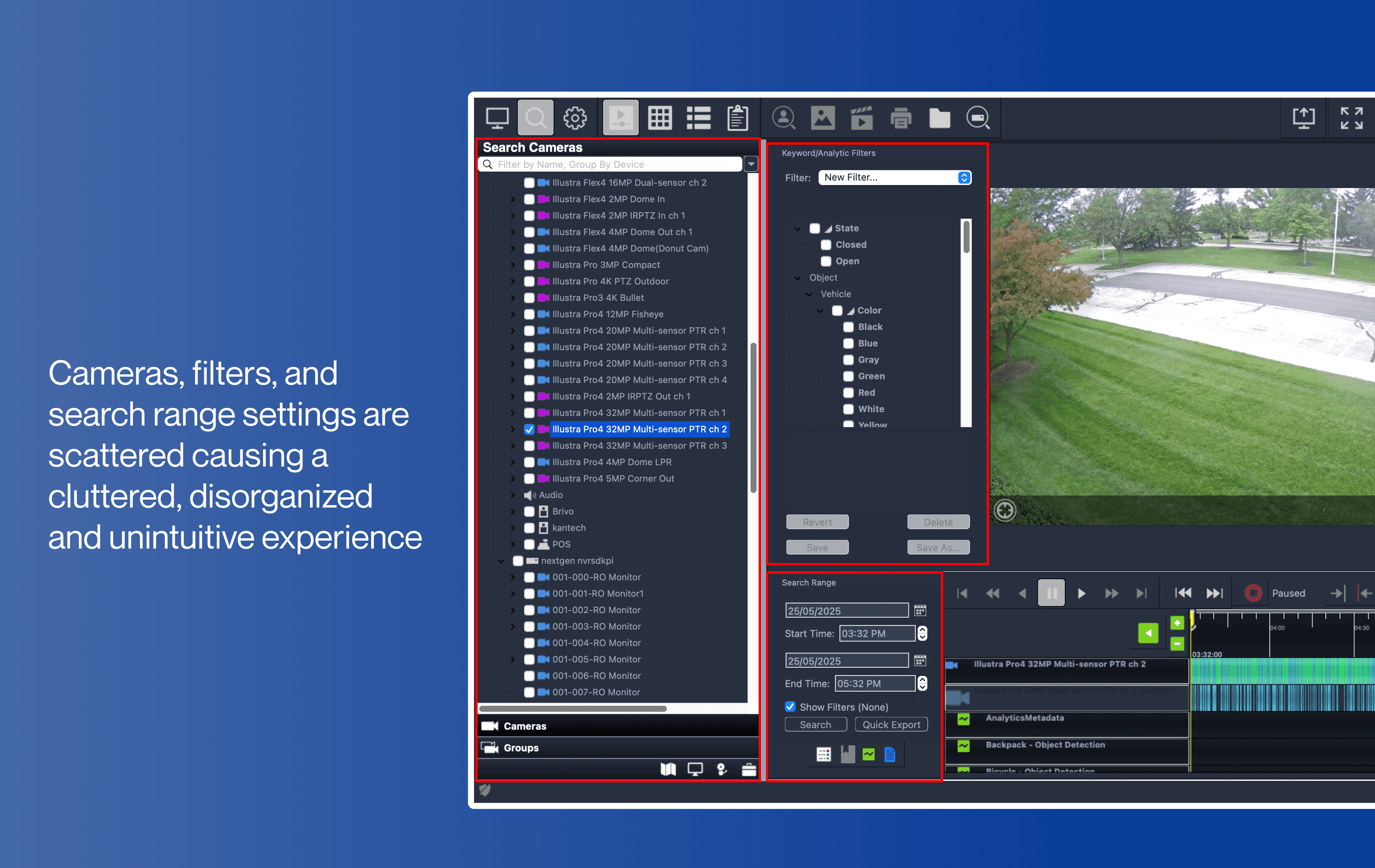
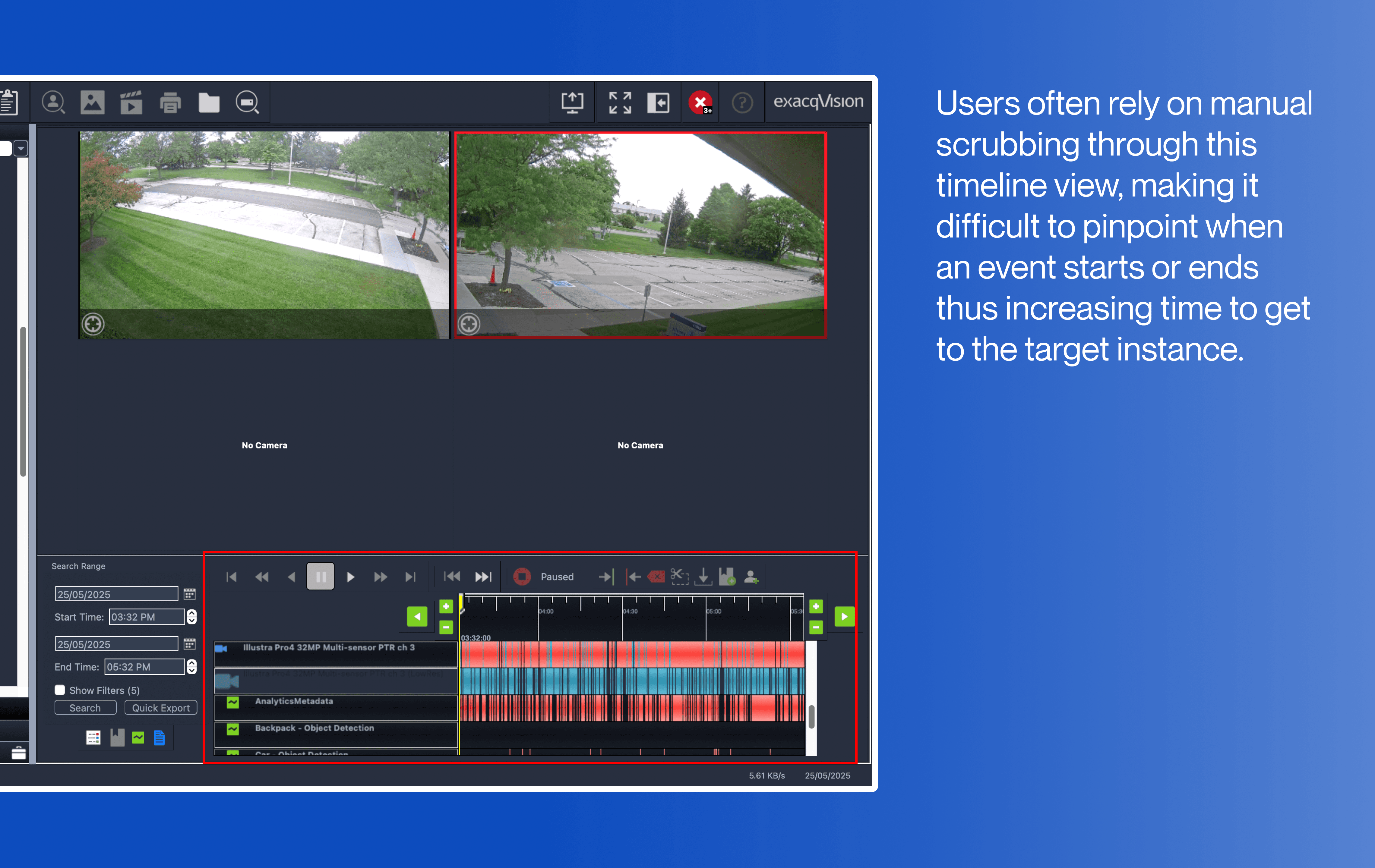
At the macro level, I mapped how security operators navigate forensic search end-to-end, identifying where they hesitated and where they abandoned tasks. At the micro level, I audited individual components to find opportunities that accelerate time-to-resolution.
Design Decision #1
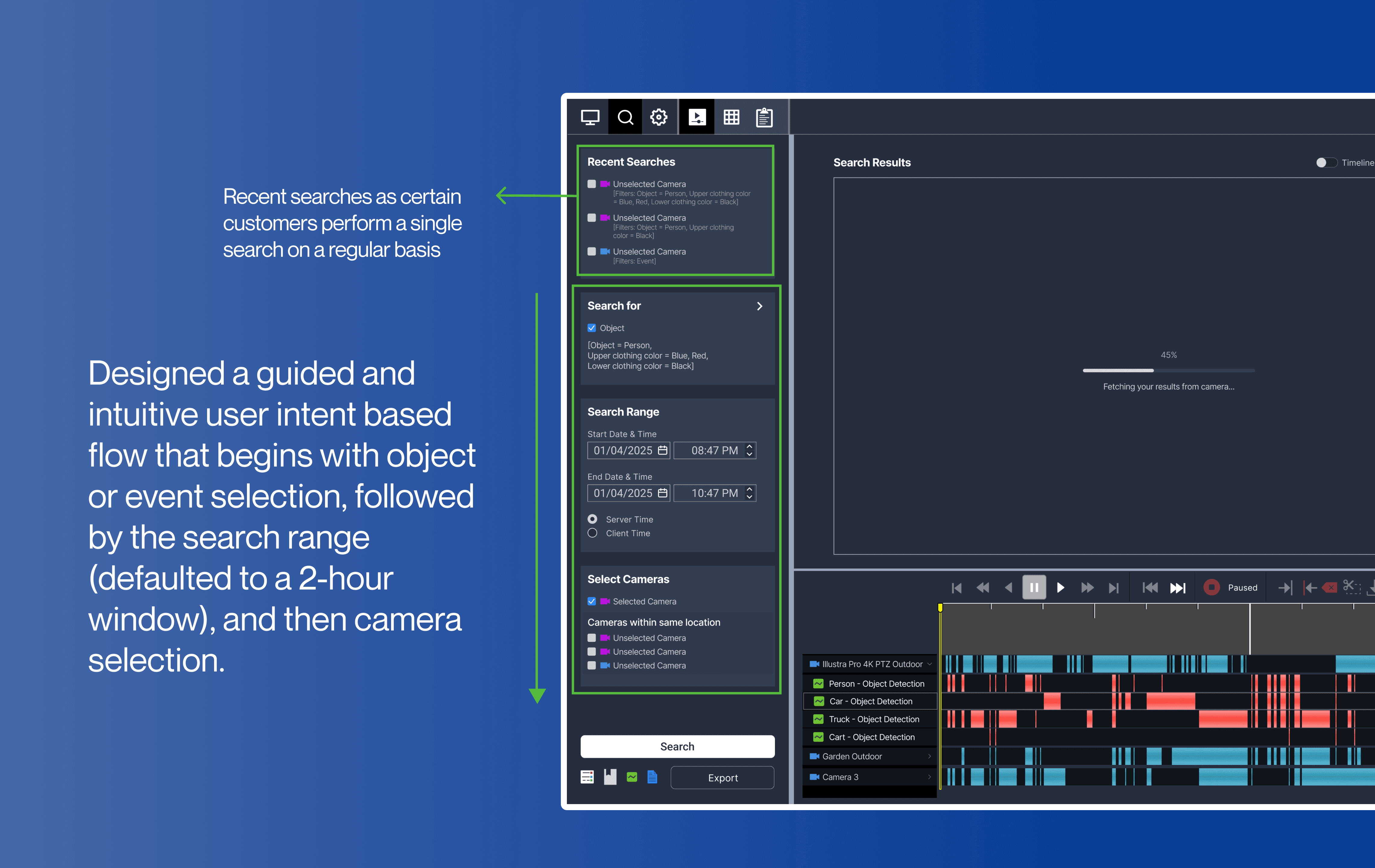
A single intent based flow that follows how security operators naturally approach a search: What , When, Where?
Design Decision #2
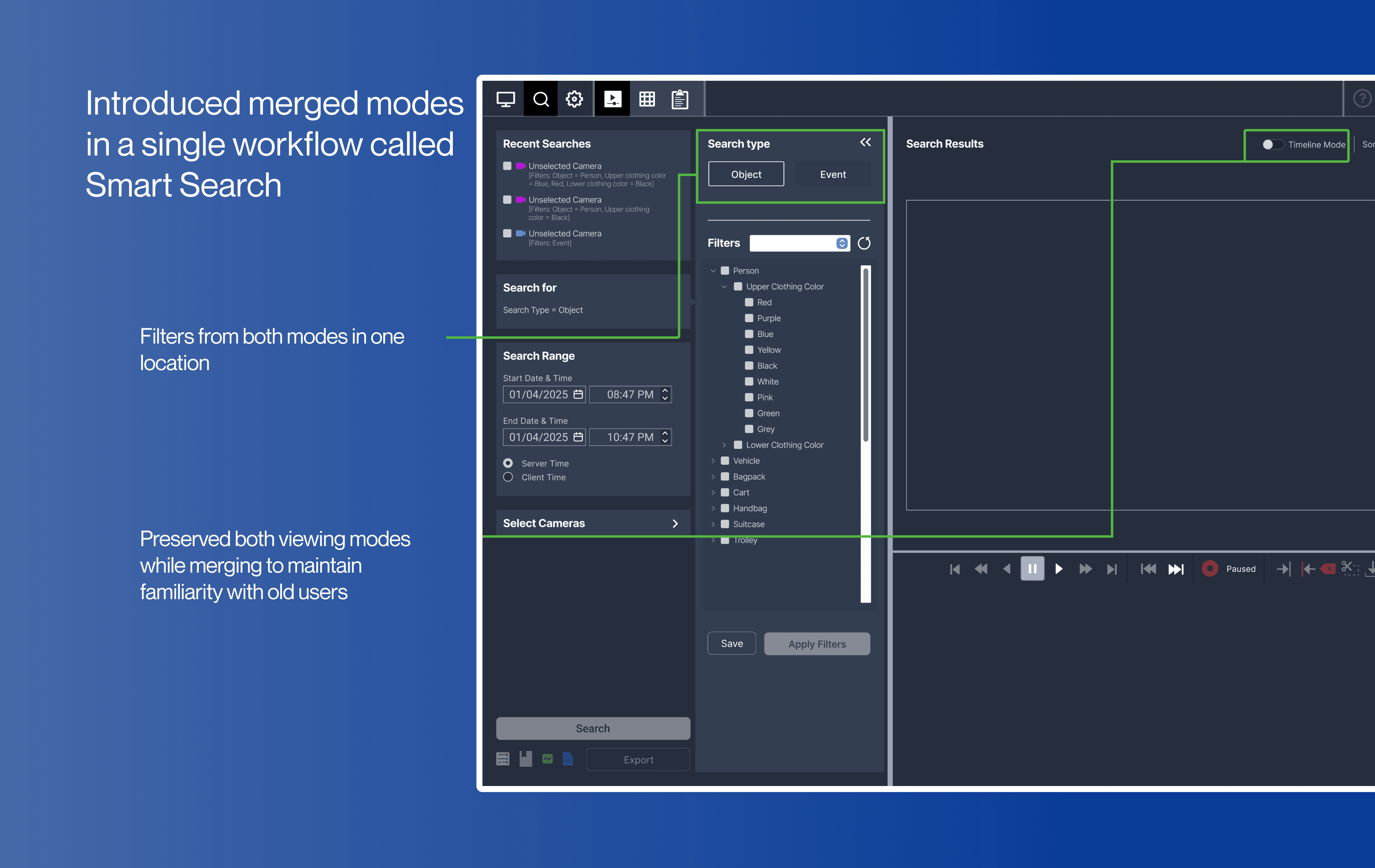
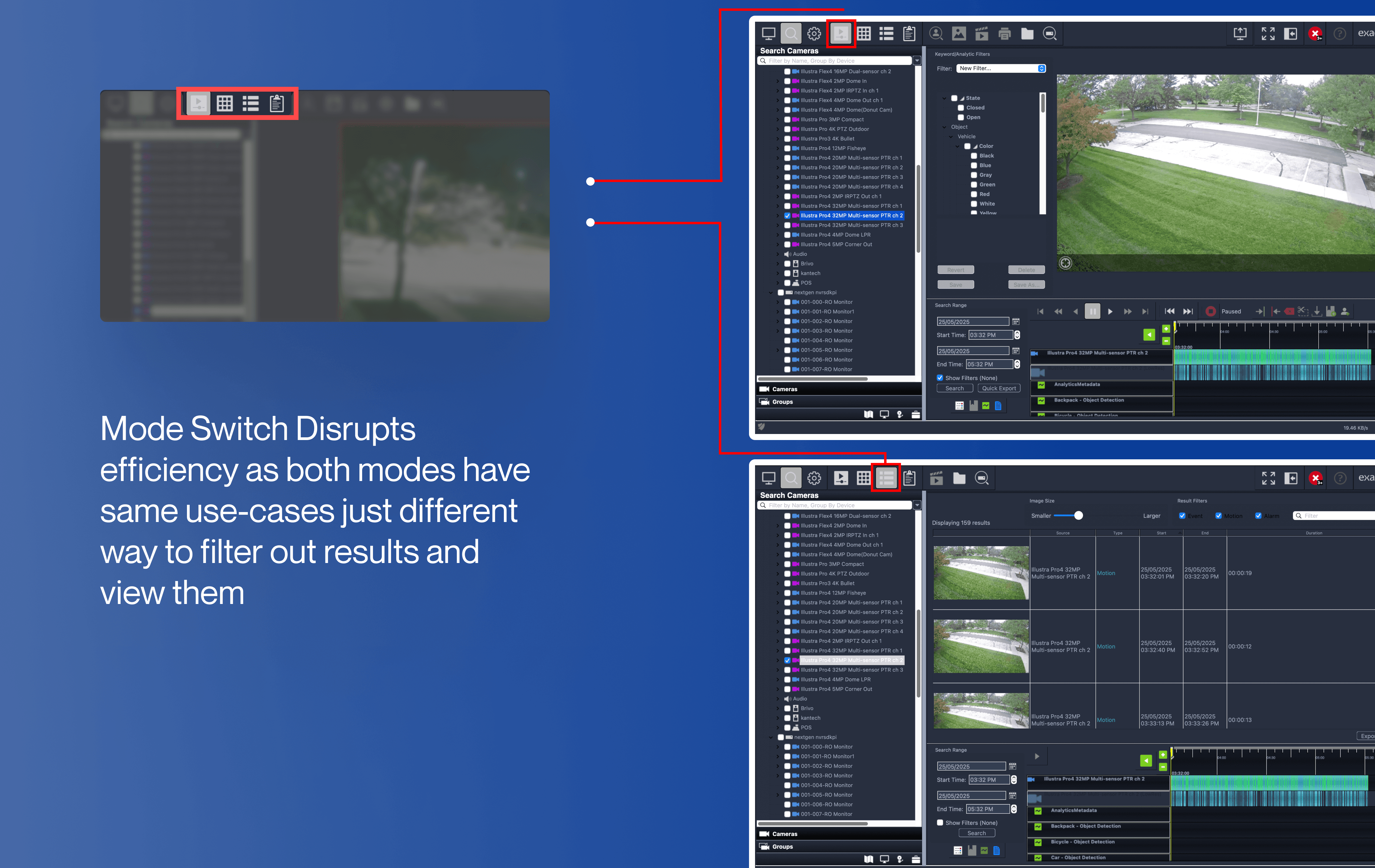
Unified two modes into a single Smart Search while preserving viewing flexibility.
Design Decision #3
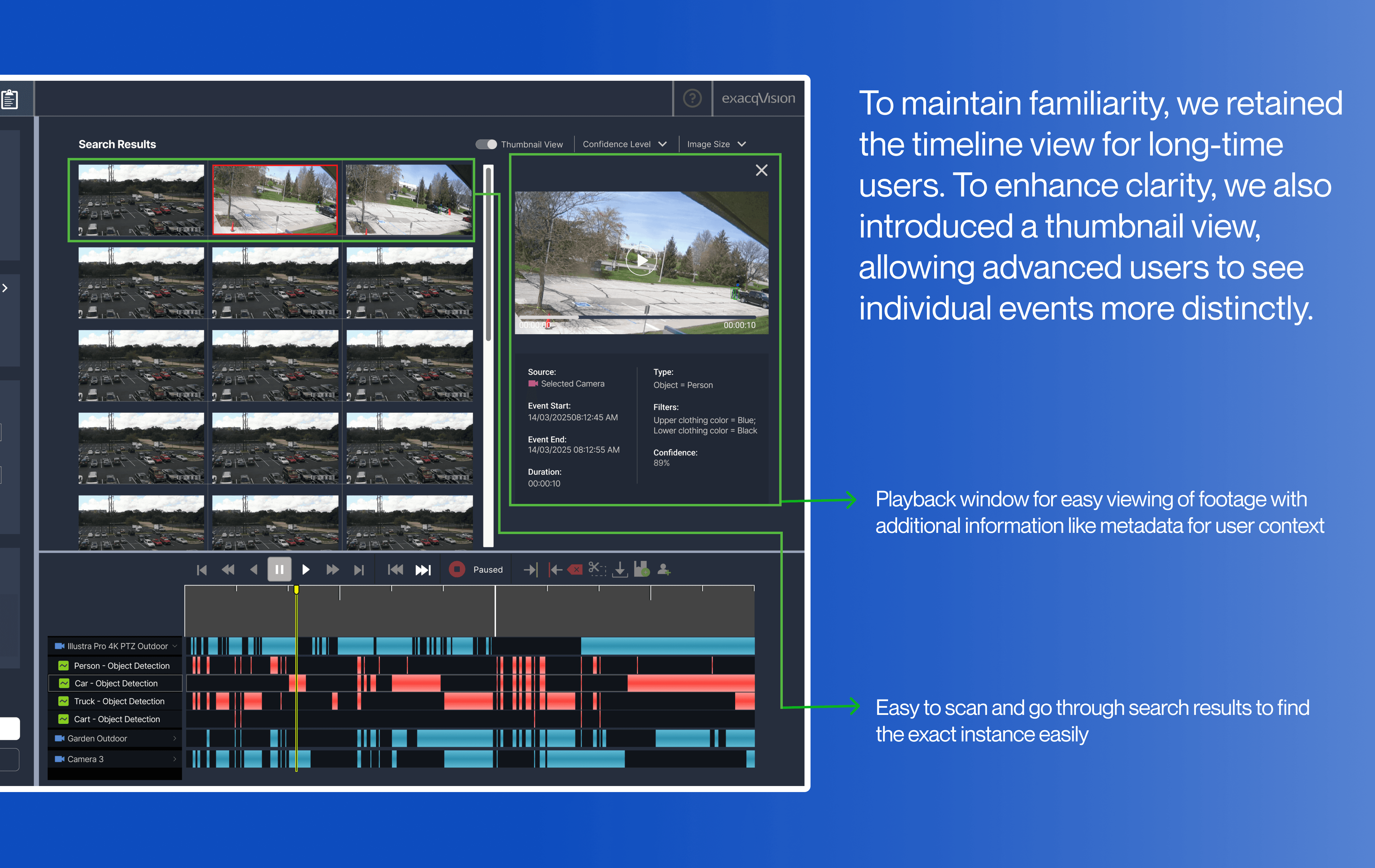
Added thumbnail view for faster scanning and timeline view retained for existing users.
Prototype
iterations
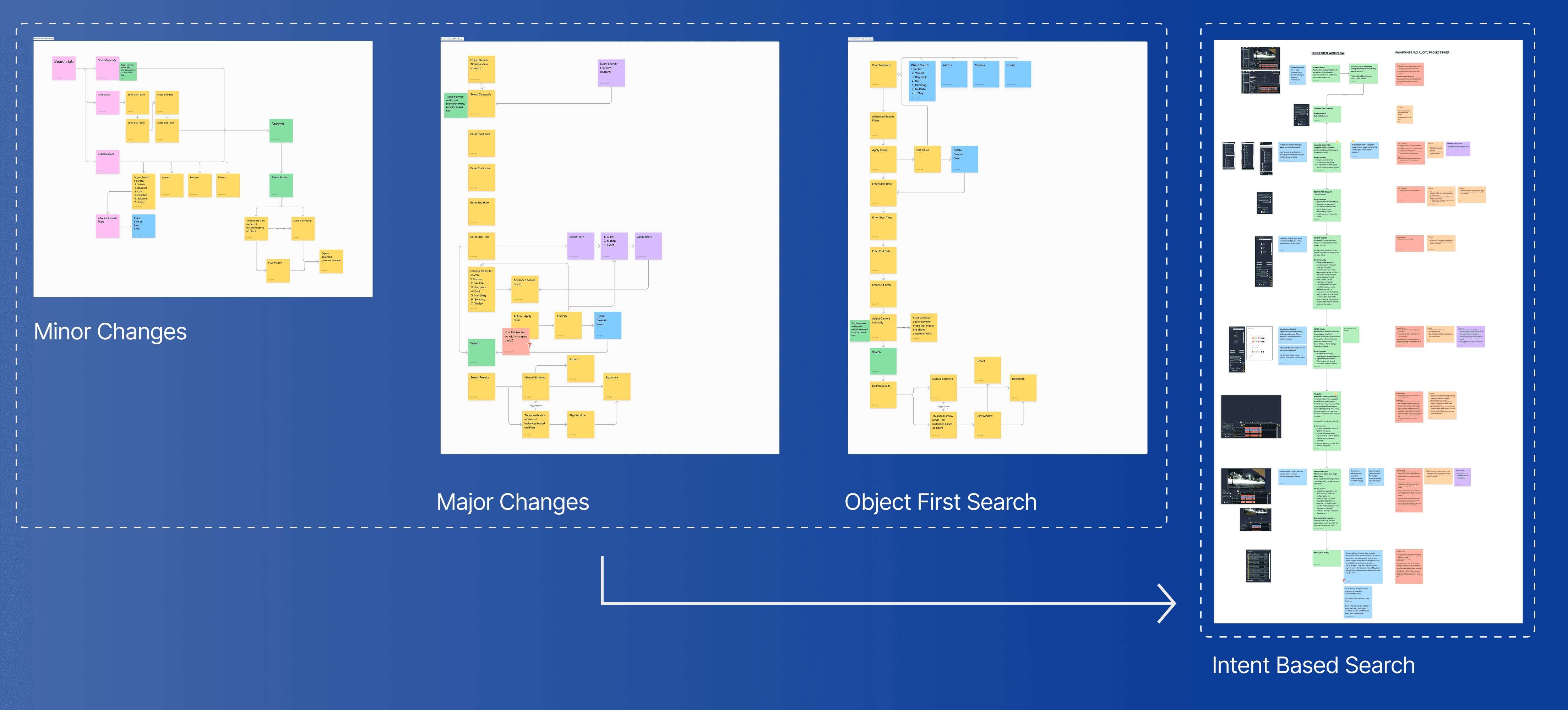
Iterated on workflows to finally landing on intent based search
Three early explorations imposed a rigid structure, which helped some users but wasn't intuitive enough to meet our goal to support novice users as revealed through testing and design reviews.
We improvised by clearly studying user intent with a focus on individual components and how they should fit together in a intent based workflow.
DESIGNING AROUND CONSTRAINTS
Edge processing architecture means latency.
Users were left waiting with no feedback, unsure if the system was working. Longer time range searches return results slowly.
We added progress indicators and surfaced results as they load, so users can start reviewing immediately.
Testing and IMPACT
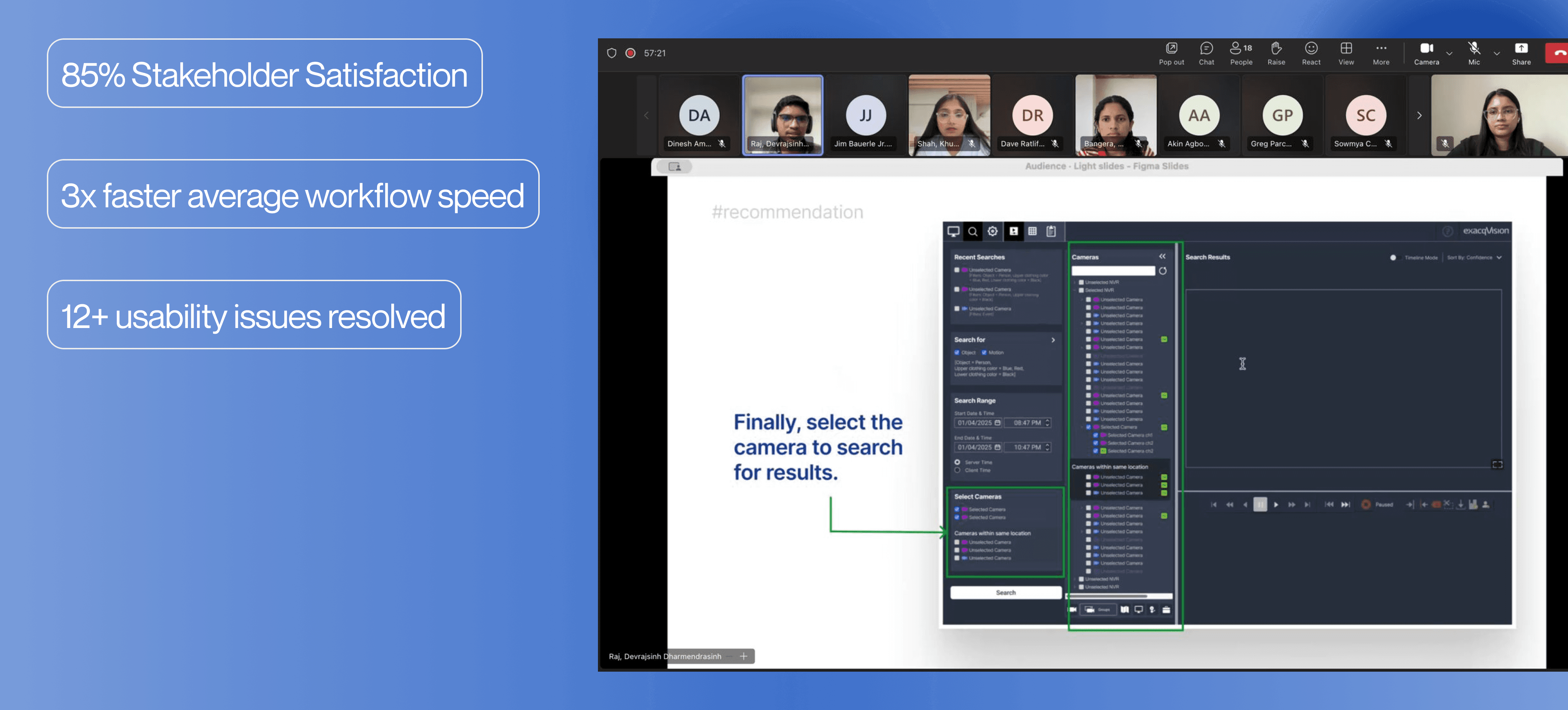
Iterative testing was conducted with 4 users and 13 stakeholders.
The solution phase 1 was shipped at the end of Q4-2024.
REFLECTIOn
Designing for complexity requires systems thinking
Working on a 20-year-old enterprise platform taught me to look beyond isolated screens and instead understand how features, workflows, and mental models interconnect. I learned how to balance technical constraints, legacy UI paradigms, and new design opportunities to bring clarity to a dense, evolving system.
Collaboration with Product and Engineering Is Key
Navigating a technically complex environment required deep collaboration. I proactively partnered with PMs and engineers to balance feasibility, business goals, and user needs, making design trade-offs that delivered measurable impact.